Friday, September 30, 2011

Non-non-trivial news

Commuting via the same old route each day can get a bit dull. Therefore even a tiniest change in the environment provides excitement. (Or at least filler material for this blog. You know, the internet is not complete yet, it needs more detailed information.)

Consider this spectacular event for example:


One day, when it was windy, there was a fallen tree on my route.I got to carry my bike over the obstacle cyclo-cross-style, then brag about it in the workplace coffee table.

Then again, not long after that, in almost exactly the same location, a P"N"WD Special Urgent Hazard Prevention Enforcement Task Force Squad Crew (or a P"N"WD SUHPETFSC for short) had prevented a potential hazard by urgently painting these markings on the road:


Apparently, bicyclists confused by the sudden metamorphosis of the bicycle path into a road without an accompanying bicycle path, and therefore riding on the sidewalk, have been a huge problem here. Or, alternatively, pedestrians walking too confidently from the sidewalk to the bicycle path were the problem. Anyway, the problem has been now solved.


By the way, you've got to appreciate the liberal application of paint here. Or did somebody just spill a bucket here? Or even worse, did a crew member think that the white stuff may have intoxicating qualities, consumed some, and then barfed all over the location? Perhaps we'll never know, but at least this marking will endure for a long time.

I'm not so sure of this stretch of pavement some metres further though: 


The asphalt seems to be rapidly turning into cobblestones here. I kind of wish that the SUHPETFSC has this thing on their TODO list as well, as they seem pretty efficient at preventing hazardous situations by improving the infrastructure.

What else? Oh yeah, I nearly flattened a squirrel today. A live one. I was going down a steep downhill in the central park at a considerable speed, when a squirrel, initially calmly squirreling away on the side of the path, decided to cross it a split-second before I was about to pass him. He made it. A couple of weeks ago I did flatten a bidon in the Tour de Helsinki 2011 in a rather similar situation, though. I guess this proves that squirrels are faster than bidons.

Sunday, August 7, 2011

Hipster championship

Yesterday, while riding around aimlessly, I incidentally got to witness the 2011 Finnish Hardcourt Hipsterity Championship Tournament:


The hipsters were apparently playing some kind of a game with clubs and a ball on their bicycles in order to determine who's the hipsterest. I have no idea who won. Perhaps the guy with a helmet cam, because I think he scored. Or then the guy with a huge, white fake beard, because he looked the awesomest.

To be honest, the game actually looked pretty fun. I don't think I'll ever engage in it though, because, while I like sports, I really suck at hipsterness, so I have no possibility of succeeding in it.

Thursday, August 4, 2011

Rollerskatin' all over the world

Hi, readers. I'm glad to announce that most of you (about 3/4) are rather intelligent, as verified by this piece of news coupled with the statistics of this blog (page views per browser, that is, for the Finnish-language-impaired):


And the 22% of you, please keep reading my blog even though you've just been tactlessly insulted. My children need wine. (Oh, it wasn't for real? Never mind what I just wrote.)

And then, towards on-topic.

"They" say that road racers are extremely good at reading road surfaces at high speeds. But there is one group of people even more concerned about the quality of the road surface: we, the rollerskaters. Bicycling on bad asphalt is uncomfortable and annoying, sometimes even dangerous, but a rollerskater is constantly at hazard because of cracks in the pavement, loose sand and rocks, curbs etc.

Bicyclists have complained for aeons (I know I have) about urban infrastructures not being designed for easy and safe bicycling. Sure, they aren't, but rollerskating is an even more neglected form of transportation. Yet, it is one of the most fun ways of commuting. Probably, the number of rollerskaters is very small, if compared e.g. to the number of bicyclists, and the city doesn't have resources, and these things take time, and everything is so difficult, yadda yadda. But "they" could do sumt'n to improve things, for sanity's sake. Couldn't they?

Like, for example, not put these huge stone walls in the way of pedestrians in every freakin' intersection:


Rollerskaters are considered pedestrians by the law, as far as I know, and therefore must go over these obstacles in every intersection. On bicycle paths there are (at least in theory) smooth ramps in intersections. But wait a minute. What is the purpose of putting these stones here anyway? They hinder rollerskaters, people pushing prams, grannies pulling their funny little bags with wheels attached, people in wheelchairs and kids who are allowed to ride bikes on sidewalks. And most people are so freakin' lazy that they walk on the bicycle paths in intersections anyway, in order to avoid lifting their feet 5 cm to get over the curb. Why can't they make smooth ramps for bicyclists and pedestrians alike?

Another thing:


Why is it that on routes for pedestrians and bicyclists, there always are seams across the path every 1,5 m? They seem to be able to make seamless roads for cars. Why can't they use similar road building technology on bicycle paths and sidewalks?

The path meant for pedestrians is often too narrow for rollerskating:


1 m of sidewalk width is not sufficient. It could be sufficient for miniature rollerskaters, such as kids, but probably not. A rollerskater needs more width than a bicyclist, because a rollerskater sways from side to side. If there's loose sand on the asphalt, as there often is, it is nearly impossible to go uphill in places like this. You practically have to walk on the skates. The stretch pictured here with less than 1 m of width and shrubbery all over the place is definitely not wide enough for a full grown man for walking, even without a kid on the side. I'm a man. Please give me wide enough sidewalks.

This (presumably a gateway to another, dark, scary dimension), I'm sure, they put in a middle of an intersection just to annoy rollerskaters:


Then there's bad visibility around corners:


Crossing this intersection on rollerskates requires multiple actions, all executed at once:
  • braking hard, because there's a hill and zero visibility around the corner
  • craning one's neck in order to see around the corner
  • observing crossing vehicles
  • observing passing and oncoming bicyclists and pedestrians
  • looking out for loose sand and rocks on the asphalt
  • jumping over the stones on the curbs
  • accelerating again on the path that is really not wide enough.
And then there are anomalies:


What the hell is that? Was there a boa constrictor lying across the road when the asphalt crew came, and they couldn't be bothered to move it, and just paved over the poor thing? And why hasn't this obstacle been smoothed out since? It's been there for years and years.

* * *

Wow. I sure have a lot of first world problems to complain about. But forgive me, complaining about stuff is my only joy in life. Well, apart from all the sex, drugs, rock'n roll, sudoku, sports and balanced family life, of course.

Thursday, July 21, 2011

Roof rack accident

Witnessed a guy with two bikes on the roof rack driving into an underground garage today, getting the bikes tangled in the ceiling structures, and probably destroying the bikes in the process. Hopefully they weren't expensive ones. Naturally, the first thing I thought was "I gotta get a picture of this". The camera of my mobile phone was in video mode though, so I got a 2 second video instead:


I feel no schadenfreude whatsoever, nor do I find anything comical about this, I'm sincerely sorry for the poor guy, because man, I can relate. I also drive with a bike on the roof rack sometimes, and I have a (verifiably no longer unwarranted) fear of doing exactly what this guy did: forgetting the bike and driving into a garage. That's why I keep silently repeating to myself "bike on roof, bike on roof..." whenever the bike is on the roof.

Friday, July 15, 2011

Learning curve pt. deux

This is what it looks like when the learning curve for a beginner mountain biker turns sharply upwards:


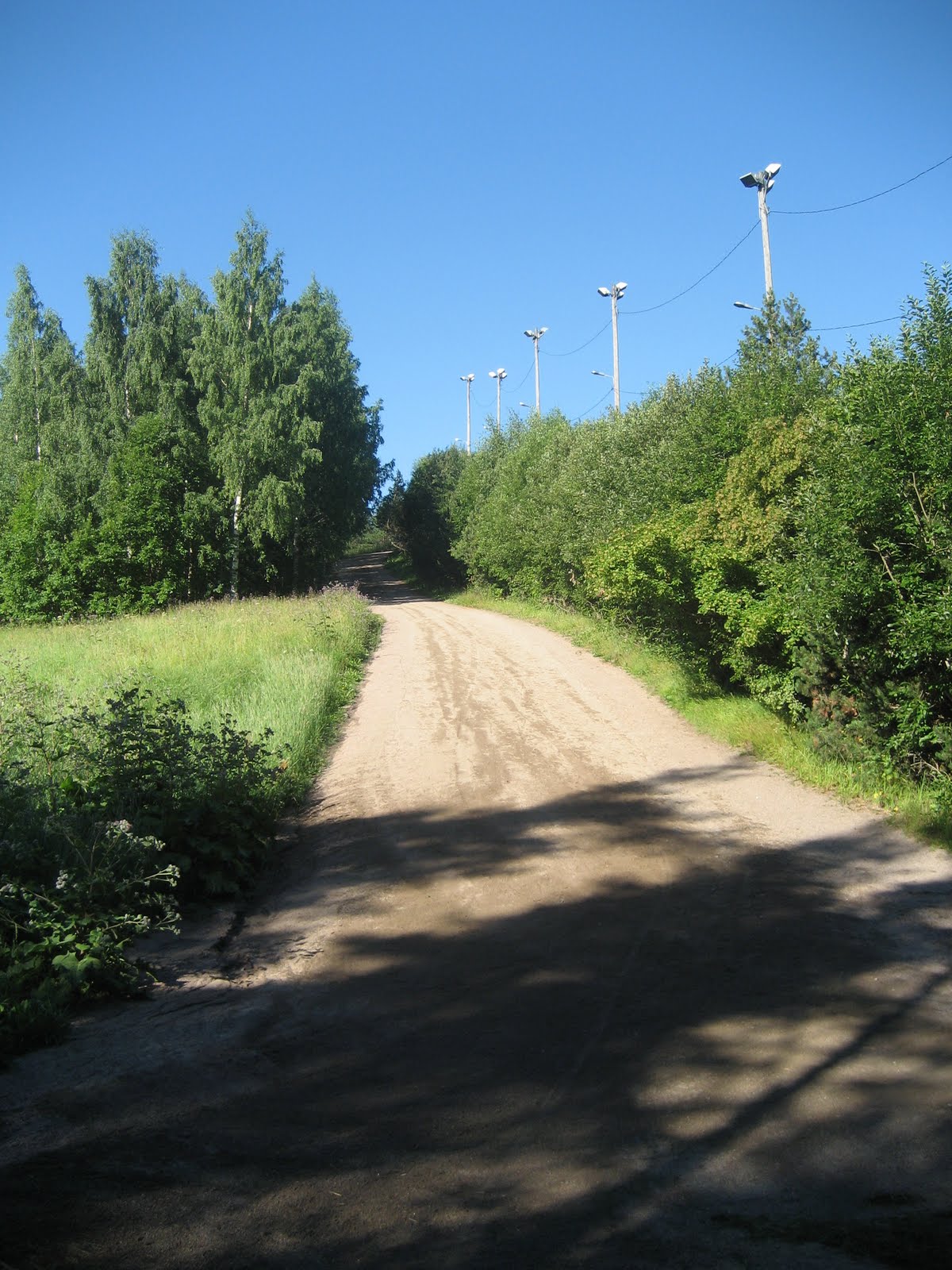
Yeah, it looks pretty lame in the photograph. In reality it is much scarier. This is the infamous Col du Paloheinä, one of the most fabled and fearsome climbs in Helsinki. The climb on the eastern side, as pictured here, is the steepest, and it stretches on and on, agonisingly, for at least 160 metres. Well. The climb is not so long, but it is really steep. According to my calculations, which may be wrong, because my sports instrument is not so accurate, and my math skills are very rusty (I even had to re-study the Pythagorean theorem for this), the average grade is exactly 37,7 %. Wow. It is so steep it is barely possible to ride it, sitting down, without doing an inadvertent wheelie and flipping over backwards. I tend to find it a bit scary. The exercise is great, but I'm slightly frightened about the flipping over backwards bit. Also, I've found out, that if you go up a really steep rise using a too big gear, you may reach a point where it becomes physically impossible to rotate the cranks anymore, and when that happens, you've got to be able to put your foot down really quick, to avoid falling over and/or backwards, and therefore you've got to be able to free your foot from the clipless pedals very fast.

I also find bicycling down very steep hills scary. Consider this one, another side of the Col du Paloheinä, for example:


Riding down hills is all fast and easy, whoopee, but what if you aren't able to become to a complete halt in the middle, because of the speed and the steepness, and the loss of traction because of the slipperiness of the surface, should the need arise? Going over the bars is always an option, but I'm a virgin in that, per se esteemed, area of bicycling, and afraid to become experienced. I might be a bit of a control freak, and it seems unlikely that I will ever become a successful downhill racer. Damn, I should have started practicing earlier, when I was still reckless. Was I ever reckless? I forget.

From the top of the Col du Paloheinä, it is possible to see the other towering giant of Helsinki, the Col du Malminkartano:


Um, if it's not possible, it's the slight hiccup on the skyline exactly in the center of the picture. It's not really, really far away either, it's some 4 km, as the crow flies. Which leads me to my next subject. Why can't they erect proper signs on bicycling routes, so it would be possible to go 4 km from A to B, within one city, on a bicycle, without consulting a map or a navigator? I can see the place I want to go to from the hilltop. It's somewhat directly westward, some 4 km from where I am located. Both A and B are places frequently visited by bicyclists. Why can't they mark the route from A to B clearly?

Here's what my route from A to B looked like, as taken from my sports instrument, on the 2nd time I went there, i.e. when I thought I already knew which way to go:


Voiceover for the markings:
A. And off we go! I'll just use my excellent memory, intuition and sense of direction to navigate to Col du Malminkartano without using any kinds of maps whatsoever.
1. Uhh... an intersection, no signs... that one seems to be in the general direction.
2. Excellent! A sign clearly stating "Malminkartano"!
3. Crap. Cycling route disappears. There's a large road, some residential streets. No signs. I know one street is a dead end from the last time I was here. I'll try another one.
4. Woohoo! Bicycling is fun. I wonder who wins today's etape. Cavendish or some other one? Wait, should I have gone some other way in the last intersection?
5. WTF? I don't know where the hell I am. Must I use the navigator on the phone again?
6. Another large road? I don't think I should cross that many.
7. Ok. If we had real mountains, they would be visible from nearby areas. This is ridiculous. I give up. I'll use the navigator, although onlookers will think I'm texting while bicycling, if I hold the phone in my hand. Yuck.
8. Yeesh. What kind of people live in neighbourhoods that look as boring as these? They must get drunk a lot to withstand the boredom.
9. Hey, that street looks somewhat familiar. Must be close.
B. Finally! It does look kind of big. I wonder what real mountains look like. I don't know what the hell those stripes are for though:


Perhaps I haven't assimilated the innermost essence of mountain biking yet, because the thing I enjoy the most in it is climbing up steep hills while wondering what it would be like to climb the mountains in the Tour de France. I've finally found a use for the granny ring, and the granniest ring in the rear cassette as well, and I'm not so sure I could manage the mountains without a triple chainring. Even though I have the "compact" chainrings in my road bike.

For instance, I gather that real mountain bikers build, and ride off of, contraptions such as these in order to make their mountain biking more exciting:


I, for one, found it exciting enought to ride down the hill very slowly, going around the ramps, albeit part of the excitement resulted from the fact that my rear brake began to squeal in a very loud, metally fashion on the top, and therefore I descended using mostly just the front brake.

It might be a good idea to get to know scary descents by riding them down very slowly on the first time, or even walking. That way you don't die so often by hitting hidden jumps (believe or not, there are several in this picture):


Or fall over in shrubs of burdock:


Although being covered in burdock isn't so bad. In fact, I believe, that it grants one a certain kind of a mountain credibility.

Thursday, July 7, 2011

Learning curve pt. I

Having all of a solid 6 weeks of experience being a mountain bicyclist, I'm proud to announce that I've already learned several things:
  • riding up hills is HARD (because hills in the woods tend to be steeper than hills on the road)
  • riding down hills is harder (and scarier) than it looks like in several Youtube mountain biking videos
  • watching a lot of Danny McAskill videos doesn't grant one excellent "bunny hop" capabilities (some practice is required also)
  • most of the trails near my neighbourhood belong in the "technical" category (as opposed to the "fast" category), I believe
  • it is possible to crush a crabon fribé seatpost by tightening the clamp too hard.
Another thing I've learned is that mountain bicyclists have magical, foldable tyres:


No, that's not what a bear coughed up after eating a snake, that is, unfolded, indeed a tyre for a mountain bike:


Even though I'm a complete novice when it comes to mountain biking, I figured that it is a good time to replace the tyre when the knobs begin to fall off:


Before:


And after:


I went for the knobbiest tyre my local bike shop had mostly because I like the intimidating sound the knobs make on pavement. Besides, I don't need good rolling qualities on the pavement because I'm way too fast for safety in the city as it is. Also, I need the traction for learning curve pt. II. To be continued...

Saturday, June 18, 2011

Evolution of the bicycle commuter

I present you a handy guide for recognizing the different stages in the evolution of the bicycle commuter. The stereotypes in this blog post are referred to as "he" for simplicity's sake, although they might as well by female. Well, most of them could. Some of them are definitely male.

The pre-beginner

The pre-beginner is totally out of touch with bicycling. The last time they rode a bike was in their teens, years or decades ago, and ever since they've been commuting by public transport or by driving. But in exceptional circumstances, once or twice in a few years maybe, they may be forced to commute by bicycle. For instance, the bus drivers may be on strike, their car broke down, or perhaps they've been viciously egged to participate in the workplace fitness campaign by coworkers.

Pre-beginners are generally clueless when it comes to bicycling. They don't know the routes, they are unfamiliar with the traffic regulations concerning bicyclists, their control of the bicycle is poor, and they may be unaccustomed to physical exercise of any kind. When stopping at traffic lights, some of them tend to jump off a moving bike instead of using the brakes to stop completely. They find bicycling hard.

However, sometimes it's possible (I hope) that the bicycling experience doesn't put off the pre-beginner completely. If they get some kind of a positive spark out of it, they may continue to commute by bicycle even when not forced by circumstances, and slowly advance up the ladder tree of evolution of the bicycle commuter.

Attitude towards bicycle technology

The pre-beginner uses whatever bicycle they've had stored in the shed for decades, or possibly borrow one from their kids or neighbours. Their awareness of the finer nuances of bicycle technology is vague at best ("- What size bicycle do you have? - Adult!"). If they're lucky, they know someone who knows the tiniest bit about bicycle maintenance -- like the fact that the chain needs to be lubed every now and then.

Dress code

Pre-beginners are totally unprepared for bicycling, so they'll wear what they always wear, like jeans, for example. Or, if it's possible, they might borrow sweatpants from their kids or neighbours. They may wear kids' size rollerblading helmets on top of their heads, if they're particularly security-oriented.
Linkki
Behaviour in traffic

Pre-beginners act shaky in traffic. They aren't aware that there's a difference between sidewalks (meant for pedestrians only) and routes meant for bicycles and pedestrians. They definitely don't want to ride on the road, where cars go. They see cars as a kind of an unstoppable force of nature, moving on along pre-destined routes, immediately running down any bicyclists that cross their paths (not totally unlike in the movie Maximum Overdrive), so they tend to yield their rights whenever possible. (In fact, most cars these days have drivers inside, who operate the cars using the steering wheel, accelerator and brakes. So, actually, it is possible for the driver to make the car avoid collisions with bicyclists, by steering and/or slowing down the car so it is directed away from the bicycle (although empiric evidence often might suggest otherwise). Some might even argue that it is the drivers' responsibility, rather than a choice, to do just that.)

The occasional commuter

The occasional commuter has caught a dose of motivation for bicycling. Somehow, they've ended up doing it every now and then, and the experience hasn't been totally repulsive. The occasional commuter hovers on the verge of getting it about bicycling.

Attitude towards bicycle technology

The occasional commuter is just about to realise that the bicycle is a diverse thing, that there are several types of bicycles, meant for various kinds of usage. However, they would like to have it all-in-one. Therefore they tend to go for a hybrid (might as well be named "compromise") or a cyclo-cross bike (= non-optimal for the road and the off-road). Anyway, the experience of having a bad bicycle for whichever usage you are trying to use it for is an essential one. If you don't know what "bad" is, how can you strive towards "good"? They will need this information when, uh, evoluting.

Dress code

Any kind of sports clothes. Some even wear unpadded bicycling shorts (yuck).

Behaviour in traffic

The occasional commuters tend to stick to the bicycle paths. Might even use the road, occasionally, if feeling exceptionally fierce.

The biltema pro

The biltema pro has commuted by bicycle enough to realize that the commuting experience can be enhanced by equipping the bike, and also the bicyclist, with accessories. He doesn't understand why anybody would invest in the real expensive stuff real bicycle shops sell though. Therefore he does his bicycle-related shopping in bargain retailer stores, such as Biltema and Motonet. His gear consists of various rear view mirrors, lamps, racks, panniers, bells and whistles. He thinks that more is more.

Attitude towards bicycle technology

The bike of choice for the biltema pro is an inexpensive, heavy hybrid. Those smaller gears do come in handy, because as a result of customization the bike has become several kilograms heavier than it was out of the box. A plusher saddle, puncture protected tires and all those racks add up surprisingly much weight. The biltema pro thinks aero bars are a great invention, but he tends to install them so that his position on the bike is as upright and comfortable as possible, so they don't really add any "aero". And what do those bulky panniers contain? Does he really carry a laptop, several books and binders and three outfits to and from work each day?

Dress code

The biltema pro favours shell suits, sneakers, fanny packs and fluorescent vests. If it's raining, he'll don a rainproof cloak that makes him look like a tent on two wheels.

Behaviour in traffic

The biltema pro grinds on, slowly, like a very lightweight train, and obeys traffic regulations.

The pragmatic commuter

The pragmatic commuter is a seasoned pro of the commuting world. He's been doing it for a certain period of time now, he's worked out most of the kinks, he knows what to do. Commuting by bike is his second nature. He usually participates in the cycling scene somehow, like following competitive cycling, participating in it, or at least, reading the forums.

Attitude towards bicycle technology

The pragmatic commuter has worked out the suitable bike for him. It may be a hybrid, a cyclo-crosser, a mountain bike, a fixie or a carbon fiber racer. It may even be an everyman bike. Probably there's more than one bike, and the pragmatic commuter decides which one to ride based on the season/weather/mood.

Dress code

The pragmatic commuter has put some thought in what to wear. Often, it's skin tight lycra, because that's what serious cyclists wear. Or, it may be girls' jeans, if they're a fixie aficionado. Anyway, it's a conscious decision.

Behaviour in traffic

The pragmatic commuter is fast. He knows (most of) the traffic rules, but has his own opinions on whether or not to obey them. He's not afraid to ride on the road.

The pragmatic commuter with satori

The pragmatic commuter with satori is just like the pragmatic commuter in every other aspect, but the satorified one doesn't need to prove anything to anyone else. They don't need to take unnecessary risks. They wont participate in the commuter category time trial competition. They won't compete with you (the bastards). Sadly, I'm not there yet.

The pitchy stump

If a bicycle commuter keeps on commuting long enough, they may mature to become a pitchy stump. A pitchy stump is totally resilient to weather, trends, advancements in technology and contradicting opinions of fellow humans. A pitchy stump keeps on doing his thing, year in year out, decade in decade out, for centuries.

Attitude towards bicycle technology

Pitchy stumps ride the bikes they've ridden for the last 40 years. Back then, bikes were built to last. Besides, they know that no significant improvements have been made in the design of the bicycle in the last century. Therefore upgrading to a new bike wouldn't benefit anything. Pitchy stumps do their own maintenance themselves, in their own garages.

Dress code

Pitchy stumps wear the sports gear they've worn for the last 40 years. Back then, sports gear was sewn to last. Besides, they know that no significant improvements have been made in the design of sports gear in the last century. Therefore upgrading to a new set of sports gear wouldn't benefit anything. Wives of pitchy stumps stitch up any damaged sports clothes with their own sewing machines.

Behaviour in traffic

The pitchy stump moves relatively slowly, but may be unpredictable in traffic. Because they're very resilient to change, they may not follow traffic regulations that are up to date, but instead follow the rules that they've learned in the century before this one. And if the choice of a route of a pitchy stump looks odd to you, bear in mind that they've bicycled along that path already when all of what you see was just a cornfield.